Main currents in American thought : An interpretation of American literature…
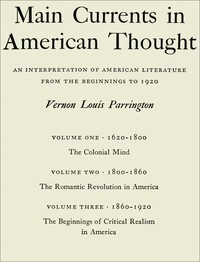
"Main currents in American thought" by Vernon Louis Parrington is a critical history of American literature and ideas written in the early 20th century. The study interprets American writing through the lenses of political, economic, and social change, tracing how European doctrines took root and reshaped themselves in the New World. It centers on the long contest between liberal-democratic impulses and conservative-theocratic or capitalistic systems, with Volume One probing the clash of
Puritan theocracy and emerging Yankee individualism in colonial New England. The opening of the work lays out a frankly liberal, Jeffersonian vantage point and explains that the inquiry follows ideas as they evolve through theology, politics, and economics rather than through belletristic schools. The introduction maps the European bequests—English Independency (natural rights), French romantic theory and Physiocracy (equality, agrarianism), and English laissez faire (commercial individualism)—and frames colonial thought as a struggle among figures like Roger Williams, Franklin, and Jefferson on one side and John Cotton, Jonathan Edwards, and Alexander Hamilton on the other. It argues that colonial literature is best understood in its polemics on church and state. Beginning Book One, the narrative shows New England shaped by freehold landholding and a mercantile spirit, producing yeomanry and gentry and the dual ideals of Puritan and Yankee. It then sketches English backgrounds: Puritanism as a middle-class, Reformation-driven movement that fostered natural rights, while Calvinist theology resisted egalitarianism in contrast to Luther’s individualist strain. The transplant to Massachusetts fused Plymouth-style congregational churches with a corporate charter that enabled a theocratic oligarchy, yet freehold property quietly seeded local democracy even as statutes and the Cambridge Platform enforced orthodoxy. Finally, the portrait of John Cotton presents the chief priestly steward of theocracy—an erudite, commanding preacher who, after the Antinomian crisis, backed coercive orthodoxy and a biblically sanctioned, aristocratic state that restricted civic power to the godly. (This is an automatically generated summary.)
Read or download for free
For an overview of the different reading options, see our Reading Guide
| Reading Options | Url | Size | |||
|---|---|---|---|---|---|
| Read now! | https://www.gutenberg.org/ebooks/78025.html.images | 4.0 MB | |||
| EPUB3 (E-readers incl. Send-to-Kindle) | https://www.gutenberg.org/ebooks/78025.epub3.images | 1.8 MB | |||
| EPUB (older E-readers) | https://www.gutenberg.org/ebooks/78025.epub.images | 1.8 MB | |||
| EPUB (no images, older E-readers) | https://www.gutenberg.org/ebooks/78025.epub.noimages | 1.7 MB | |||
| Kindle | https://www.gutenberg.org/ebooks/78025.kf8.images | 2.9 MB | |||
| older Kindles | https://www.gutenberg.org/ebooks/78025.kindle.images | 2.5 MB | |||
| Plain Text UTF-8 | https://www.gutenberg.org/ebooks/78025.txt.utf-8 | 3.3 MB | |||
| Download HTML (zip) | https://www.gutenberg.org/cache/epub/78025/pg78025-h.zip | 1.6 MB | |||
| There may be more files related to this item. | |||||
Similar Books
About this eBook
| Author | Parrington, Vernon Louis, 1871-1929 |
|---|---|
| LoC No. | 2010681773 |
| Title | Main currents in American thought : An interpretation of American literature from the beginnings to 1920 |
| Original Publication | New York: Harcourt, Brace and Company, 1927, copyright 1930. |
| Contents | v. 1. 1620-1800. The colonial mind -- v. 2. 1800-1860. The romantic revolution in America -- v. 3. 1860-1920. The beginnings of critical realism in America; completed to 1900 only -- Addenda. |
| Credits | Sean/IB—@ParchmentGlow |
| Language | English |
| LoC Class | PS: Language and Literatures: American and Canadian literature |
| Subject | United States -- Politics and government |
| Subject | United States -- Civilization |
| Subject | American literature -- History and criticism |
| Subject | Philosophy, American |
| Subject | United States -- Religion |
| Subject | United States -- Intellectual life |
| Category | Text |
| EBook-No. | 78025 |
| Release Date | Feb 24, 2026 |
| Copyright Status | Public domain in the USA. |
| Downloads | 6010 downloads in the last 30 days. |
| Project Gutenberg eBooks are always free! | |